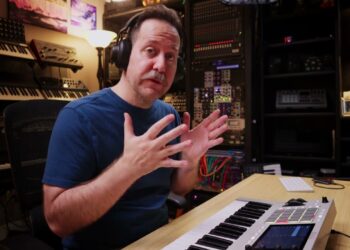





Paul Thomson walks through a film-style cue written using libraries recorded at AIR Studios.
Paul focuses on how a cue can feel performed rather than fixed to the grid and focuses on tempo mapping to shape momentum through the orchestra, giving fast passages time to speak and letting phrases breathe into the next idea. In the middle section, using the Quipi Theorem, the music moves in free time, away from the click, creating a looser sense of flow.
The orchestration develops through motion. Scales, shifting harmony, and small clashes keep the cue alive, while each instrument adds a particular edge to the texture. Piccolo and xylophone bring definition to the attack. Woodwinds and strings carry the body of the line. Choir gives the harmony a more charged emotional colour.
Across the session, Paul draws from a wide AIR-recorded palette. Spitfire Symphony Orchestra forms the orchestral foundation, with performance patches responding naturally to the way parts are played. Percussion Swarm brings animated textures recorded with Frank Ricotti, Paul Clarvis, and Gary Kettel. Polaris translates electronic gestures into string writing. Eric Whitacre Choir adds a pure vocal dimension, while Cimbalom, Aluphone, and Harp Swarm extend the colour of the room in more unusual directions.
Paul also reflects on AIR Studios as the birthplace of Spitfire Audio. The first test session began with six violinists and a simple aim: to record samples in a way that felt closer to real orchestral performance. Players were placed in their natural positions, the room was allowed to speak, and the detail of elite London session musicians became part of the sound.
From the early British Modular Library sessions to Spitfire Symphony Orchestra today, that approach continues to shape the AIR Studios catalogue: musical detail, natural positioning, and the character of Lyndhurst Hall captured at the source.
https://www.spitfireaudio.com/pages/spitfire-audio-libraries-recorded-at-air-studios-london
00:00 AIR Studios and Spitfire Audio Origins
01:47 Full Demo Playback
04:10 Tempo Map and Storytelling
10:51 Percussion Colours and Textures
16:10 Piano, Strings, and Eric Whitacre Choir Layers
24:44 SSO Piano and Opening Runs
27:39 Orchestration and Articulation Workflow
32:26 Recording Philosophy and Final Playback